INDEX
Uster Showcasing Jossi Vision Shield
Fiber cleaning system can detect and eject any particle that shows the slightest difference in color from the main fiber

By: Tara Olivo
Associate Editor at Nonwovens Industry
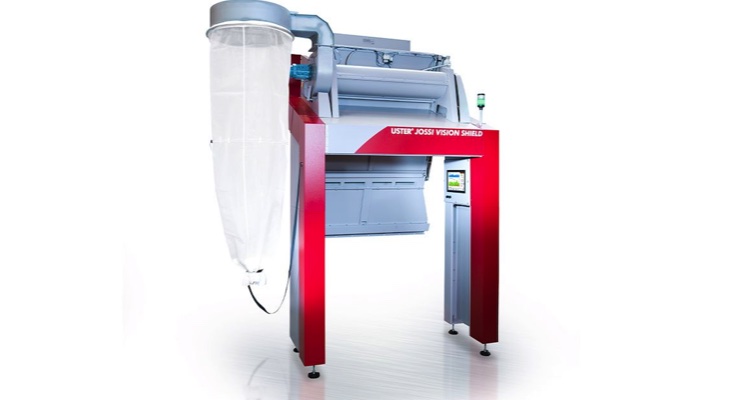
Contamination is an important quality topic for nonwovens producers – whether using synthetic or natural fibers. To prevent unwanted residual fibers getting into the production process, they should be eliminated at the earliest possible stage – at fiber preparation.
Uster Jossi Vision Shield N delivers impressive performance in its ideal location, directly after the fine opener. Here, the fiber cleaning system, with its unique imaging spectroscopes, can detect and eject any particle which shows the slightest difference in color from the main fiber. With contaminants such as black spots (e.g. rubber particles), detection and elimination can be guaranteed down to a size of one square millimeter. All shades of colored contaminants – such as polypropylene fragments, cotton fibers or any other material – can be reliably detected down to the same one square millimeter size. Melting points in synthetic fibers (slightly colored, yellowish in appearance) as small as one square millimeter can also be removed effectively.
Uster believes the range of applications in which contamination control is vital will grow in future. “The trend for using recycled fibers in the drive for sustainability in textiles certainly won’t stop at the gates of nonwovens mills,” says Mario Siegenthaler, product manager Fiber Cleaning, Uster Technologies AG. “Goods made of recycled fibers bring attractive margins and healthy business, as long as quality requirements are fulfilled. However, it is a proven fact that recycled fibers are still today prone to infinite and inconsistent quality variations. Operating a high-performance contamination sorter in the production line is the best way to ensure an acceptable end-product.”
Regarding natural fibers, producers using bleached cotton feel often unsure about meeting the required high-quality standards. To minimize the risk of claims for contaminated end-products, some have opted to install two contamination sorters in a row, one after the other. But, according to Siegenthaler, this certainly is not having the desired effect on increasing efficiency. “Optimum performance from a fiber cleaning system is achieved when the fiber tufts are fully and homogeneously opened. For that reason, the Uster Jossi Vision Shield is positioned immediately after the fine opener. Placing a second cleaning system in line, without a tuft opener, will not give the desired cleaning performance,” he says.
Mario Siegenthaler and other Uster experts will be available for first-hand information at INDEX 2023 in Geneva, Switzerland, from April 18 to 21, at Booth 4012.